1) Inspired by the poets, Thomas Miller went and changed his name. Instead of picking the pedestrian trochee “Dylan”, he chose the graceful iamb “Verlaine.”
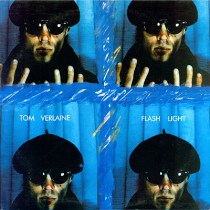
2) He isn’t just into the french symbolist poets. He’s also into a certain artist/bohemian fashion move forever linked with France. Tom Verlaine has been known to wear berets . He even wears one on the album cover of Flash Light. Dear Lord, he even WEARS THEM ONSTAGE. This clearly demonstrates the kind of admirable indifference to accusations of sartorial pretension that a lesser man couldn’t even begin to contrive.
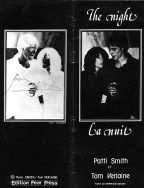
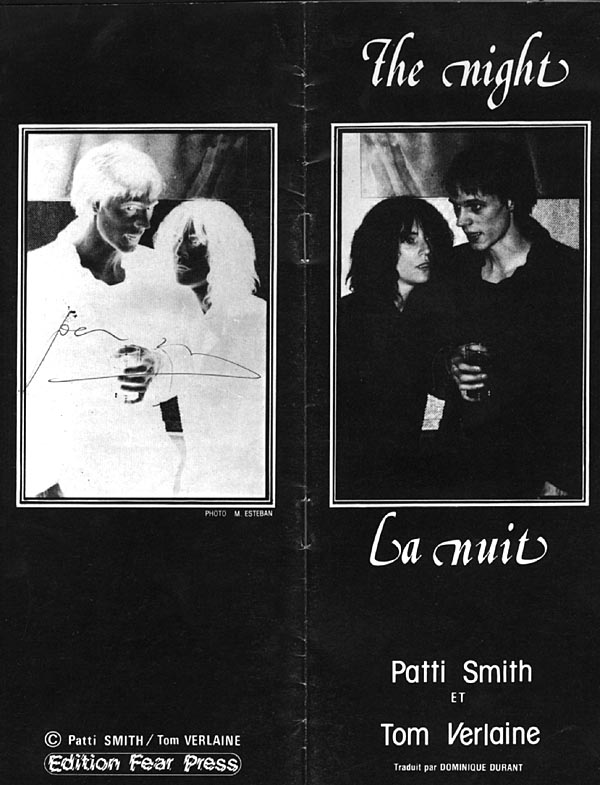
3) Tom used to date Patti Smith. Ok, ok, I admit that sounds a little juvenile on the page. Let’s move on and consider the fact that, aside from performing what must have been amazing shows together, they also collaborated together on The Night, a slim wee volume of poetry steeped in Rimbaud and the drug induced freestyle nature of Bob Dylan’s L.P liner notes (which were of course steeped in Rimbaud.) They take turns writing alternate stanzas: Smith the odd, Verlaine the even. It’s intense. New York’s very own derangement of the senses – a by-product of the type of blood that runs through the veins of artists who are in the process of discovering they are artists.
4) Sure Sonic Youth were the band that made jazzmasters cool, but Tom Verlaine was using them waaaay earlier, and his utilisation of the whammy bar as a mode of expression is right up there with Neil Young and his omnipresent bigsby.
5) Despite having every album he’s ever been a part of since Marquee Moon compared to Marquee Moon and found a little wanting, he still puts out records. Just like Nas after Illmatic! Eighties songs like Foolish Hearts and The Scientist Writes a Letter , prettier and more delicate than anything he made with Television, show just how unconcerned he was with placating anyone desperate for “Marquee Moon 2”. (Fair enough if you are suspicious of anyone all of a sudden adding synths in the eighties but these songs still sound like noone but Verlaine.)
6) He seems relatively apathetic to the press. I suppose it sounds even pettier to love someone for this than to criticise them for it. I am petty, but I am not merely petty, so I should add that when he’s offered the kind of in-depth interview his creative legacy actually warrants, it’s more likely to happen in Brazil than New York, and this 3 part interview is a pearler.
7) The dude travels at his own pace. As with former TV sidekick Richard Lloyd, Verlaine could not be accused of a prolific output, but he’s often involved in projects not particularly suited to treading the rock n’ roll gig circuit and keeping ones P.R hustle on, like being the soundtrack to a silent Man Ray film.
8) Considering Television came out of a scene forever associated with the roots of punk, it’s hard not to notice that Verlaine has recorded some of the most crytsalline guitar tones in the history of rock n’ roll. The gain on his amp must surely be turned to sweet f### all when he performs Days on the Mountain Part 1 on The Old Grey Whistle Test (collected on Volume 2 of the dvd series fyi.) In fact, I remember watching it with a friend who commented “That’s so clean. Almost alien clean!”
You mean you’ve been thinking this too? Well then let me come right out and say it: the following rock n’ roll syllogism IS completely justified:
gain at sweet f### all in rock n’ roll = defiance
defiance = defining virtue of punk
∴ GAIN AT SWEET F### ALL = PUNK
All existing internet clips of that performance seem to have been taken down for copyright reasons, so you’ll just have to buy the dvd. Or torrent it. But till then, check out the studio version. His jazzmaster occasionally sounds like an actual jazz guitar.)
9) He is no guitar pedal junkie. You’ll note during this performance of 1880 or So from the underated third TV album (performed on Later with Jools Holland), that when he wants more juice at the 4 minute mark he doesn’t stomp on no volume booster pedal. No siree. He just leans over and turns up his amp. Ah bless.
10) As already noted, Verlaine’s solo records have never been seen as particularly vital when placed beside the jaw-dropping constellation of twin guitar electric luminescence that he and Richard Lloyd carved out on the debut record Television released back in 1977. Allow me to hold up the song Words From the Front, from the 1982 album of the same name, as an example of just how compelling Verlaine could still be when left, sans Lloyd, to his own musical devices. (It has to be said that even the ‘photo of Verlaine wearing beret’ album cover seems preferable to the ‘painting of Verlaine holding cigarette’ cover they went with for Words From the Front.)
“January 23rd
There’s no road”
Now that is an opening. Over a few brooding chords and overdubbed arpeggios that seem to quietly circle each other, our beret-clad, french symbolist-obsessed, former Patti Smith-dating, jazzmaster-wielding, whammy bar-whammying, smoke-exhaling hero proceeds to lead us through some of the trials of war, not adding a vocal melody to the lyric until the first chorus. Yes – he leads us through some of the trials of war (imposing weather conditions, sedated surgeons failing to save the wounded, yearning for home, orders to attack), but let it be known, fellow respected mortal, that he does not risk the cardinal hubris of trying to SING, of all bloody things, about the inconceivable blood and guts horror of military combat.
What he does dare express, with poetic humility, is the perpetual night of human conflict, and the strangely graceful order with which imminent chaos is approached by those ordered to do just that:
“It’s hard to see
Who is about
The fires we light
Soon smoulder out”
“Up on the ridge
They’re dug in deep
We move in waves
As if asleep”
Unsurprisingly, Words From the Front as a listening experience is still heavily defined by the guitar. This is Tom Verlaine we’re talking about and he plays two mean as solos on this track. The second one is the axe-grinding high point of the song for me. It’s the sound of a player whose ingrained sense of melodic progression never lets him descend into mere noodling even when he’s cutting loose, just prowling up and down the fretboard trying to hold some kind of ground. Occasionally, when Verlaine is taking no prisoners with that whammy bar, somehow able to vibrato the shit out of so many notes without everything just falling apart, it’s the sound of someone who just happens to be holding a guitar, and who just happens to know how to play it, but whose ingrained sense of melodic progression is being displaced by more pressing concerns. It sounds urgent. Whether you want to see it as the musical expression of the inconceivable blood and guts horror of combat (which I trust you’ll agree could not possibly be expected of any guitar solo remotely tonal) or just the evocation of a squirming, stricken mind, does not much matter. What happens at around the 5:40 mark is what matters to these ears. It’s the part that always gets me. He suddenly breaks on through, seamlessly shifting into the type of guitar figure more commonly found in fingerpicked acoustic music. It’s a momentary fragment of the type of 2 or 3-string motif that is more the domain of anti-soloists like Peter Buck and John Fahey – 1 string doing all the melodic work while the constant chime of the string beside it seems to want to prevent it from travelling too far off the beaten track, or God forbid, breaking into some kind of display of virtuosity. Out here on the front it doesn’t sound like Buck or Fahey. Here it sounds like an emergence: the sudden discovery, however brief, of what might just be a way to get the hell out.
We do not get the hell out. There are a few lines left to be spoken, the audible fragment of which is “January 23rd.” We’re back where we started, except now with a still highly agitated lead guitar refusing to make way for the vocal. The songs ends.
Except it doesn’t.
It fades out.
And whilst the ‘fade out’ as a studio effect was more often than not used way back when to keep radio-friendly songs under 3 minutes, or to remove the need for that perfect ending that couldn’t be found before deadline, in this case it seems the lack of closure has nothing to do with not knowing how to finish a song. Some fade outs are more thematically justified than others.
Alas there is no way for one to fade out a blog post. Not without looking like one is trying a little too hard at least. What I can do is leave you with an excerpt from a poem (yeah yeah I know, nothing worse than someone getting all “here’s an excerpt from a poem”, but still . . .) – a statement of aesthetic intent that for me goes some way towards summing up what makes Tom Verlaine the type of guitarist who ought to be turned up to eleven when he is on your stereo (even on those occasions when he has the gain set to sweet f### all):
“O formal and elaborate I choose you
but I love too the spare, the hit-or-miss,
the mad, I sometimes can’t always tell them apart”
Dream Song 265 – John Berryman


 herriotrow.com